
Here’s a perk you don’t see everyday… an office skating rink. This shot of the rink behind the AideRSS office was taken by their chief marketer Kevin Thomason. Hat tip to Ali Asaria of Well.ca.
Here’s a perk you don’t see everyday… an office skating rink. This shot of the rink behind the AideRSS office was taken by their chief marketer Kevin Thomason. Hat tip to Ali Asaria of Well.ca.
StartupNorth.ca and WirelessNorth.ca will be offering sponsorship opportunities in the near future. 6 placements will be available on each site and accepted advertisers will match the message and editorial policies of StartupNorth.
Specifications
If you are interested, please contact us for pricing:
 I thought it was worth mentioning that Joseph Thornley, who blogs at ProPr and is based in Ottawa, has decided to eat some of his own Social Media dogfood and has released two wordpress plugins today along with 76Design.
FriendsRoll reminds me a lot of, well, a traditional blogroll. The big difference however is that it has a form which friends can fill out and request to be added to your FriendsRoll. It is a cool and simple way to keep blogrolls a little more fresh over time. Right now they usually get stale with old blogs that aren’t maintained, or people who are not blogging about different, less relevant, subjects.
The other widget, TopLinks, automatically keeps track of what sites you are linking to in your blog posts and it lists them in the widget, ordered by popularity.
Both of these widgets help create mini little networks between blogs, but require little ongoing maintenance. I will be installing them on my personal blog as soon as I update my template.
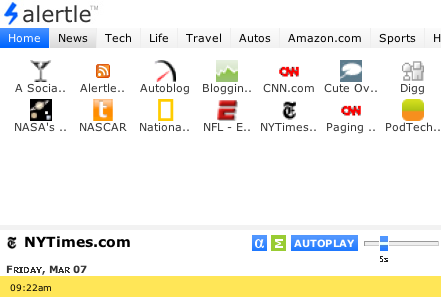 Alertle, a Toronto, Ontario startup is an RSS Reader that is focused on breaking out beyond the more technically inclined crowd that uses services like Google Reader and Bloglines.
The company, which has been bootstrapped so far, has been making quick progress. I have used their reader a few times in the last month and there has been obvious progress on the UI and the general flow of the applications.
When you first log in, the most noticible difference between Alertle and other RSS readers is their focus on “bundles” of feeds. While most readers come with a large set of default feeds, Alertle takes it a step further and provides almost 20 bundles, each with well over a dozen feeds. These include bundles like “Life”, “Autos”, “Videos”, “Nasdaq” and more.
Alertle really goes beyond just being a feed reader and really offers an easy way for a novice user to change how the browse the web in general. Their interface is relatively easy, but does take some getting used to (at least if you approach it from a traditional feed-reading mindset like I did), but I have found that it grows on you. My one complaint is that the titles of the feeds, which appear below nice large icons, are often cut short and are hard to read. I would prefer to have the titles displayed clearly and in full somehow.
I was able to easily import my existing subscriptions from Google Reader using OPML, and I think that with a little tweaking I could really get used to this interface. I really appreciate how uncluttered the display window is for the news item that is currently being read, and the list of unread posts is also clear and easy to navigate.
Alertle plans to generate revenue through advertising and potentially by offering a premium product for enterprise customers. I can imagine that there will be other revenue opportunities for them as well if they manage to build up their user base, such as charging for inclusion as a default feed and generating revenue through Google search referral if they can convince users to make Alertle their default homepage.
 Jonas and I dropped by the Savvica offices today for the launch of LearnHub.com. LearnHub is the first site from Savvica since their funding in the fall of 2007. We previously covered the return of Savvica’s founders, John and Malgosia, back to Toronto after a year in San Francisco. Savvica is based in Toronto and recently took significant investment from Indian e-learning company Educomp.
 LearnHub is in many ways the evolution of their first product, Nuvvo, which was a much more traditional learning management system. LearnHub on the other hand has a lot more social networking functionality and the “community” model feels a lot more engaging.
Users can connect with other people, can join communities and can help build courses in those communities by bundling tools such as “Debates”, “Lessons”, “Tests” and “Discussions”. There is also an explicit “Authority Ranking” in LearnHub that rewards users who participate more regularly and in more ways.
Once you have built a course, you then have the option of charging for it. LearnHub becomes a marketplace for online courses where experts in a subject area can quickly and easily build courses and then make money by charging for them. There is a lot of potential here if LearnHub can get enough exposure and adoption inside the right communities. They then also have to attract a mass audience who will pay for these courses.
By running their own support site as a community on LearnHub, Savvica is eating its own dogfood. The support site gives the best demonstration of how a community can be structured and how the different components of the community can be used differently.
In talking to the John and Malgosia, it became obvious that this is just the beginning of their long-term strategy. Without giving away the secret sauce, I can say that I was happy to hear that their revenue model was much more mature than you might assume up front.
 Ontogenix, based in Toronto, has been developing its patent pending social media ad serving technology for the last 3 years. Things are looking up, earlier today we heard Ontogenix landed a substantial round from venture capital fund GrowthWorks and strategic investor Pareto Corp (TSE: PTO).
The company was founded in 2005 by Amit Kanigsberg (former Pareto CTO), Josh Mozersky (Queen’s University Professor of Logic), and Daniel Veidlinger (California State University Professor of Linguistics). As part of the funding round, Ontogenix is bringing on serial tech entrepreneur Chetan Mathur as Chairman and industry expert Marc Ruxin (SVP Digital Strategy & Innovation for McCann Worldgroup in San Francisco) as a board member.
Ontogenix is raising the round to go to market with their first product, an Interest Correlation Engine. The technology is designed to increase the relevance of ads presented on social media sites (e.g. Facebook, MySpace, etc.) by targeting users based on their individual interests. The company searches for information on the general public’s interests, attitudes, and opinions on hundreds of publicly available sources such as social networks, blogs, and forums. This information, collected in aggregate to preserve user privacy, is then combined with the company?s proprietary data model to form the basis for a predictive engine that can tell advertisers which ads will have high relevance to different types of users.
A number of companies are gunning for this market including Lookery and Lotame. In pilot tests, Ontogenix was able to increase click through rates by 400%. With Google publicly expressing remorse for the $900M guaranteed ad deal with MySpace and Facebook being lambasted for their Beacon program, it is high time someone figured out a better way to serve ads on social networks; we’re hoping it’s a Canadian startup.
You know the drill. You have a good idea, you are pretty excited about it. Sure, you would be lying if you said you had it all figured out, but you are smart enough to know you have something.
Then it starts. All of those joe-shmoe monday morning quarterbacks start doling out advice. Time after time, you get the same advice: “It’ll never fly”.
Let me tell you something, unless the best of the best are telling you that, then you should just turn away. Any successful startup has to start with an audacious idea. If your idea isn’t just crazy enough, it will never amount to anything special.
Audacious
1 a: intrepidly daring : adventurous
2: marked by originality and verve
My favorite startups have all started on the crazy side of nutty. You can look at the now-established former starts that began as simply out there ideas. Amazon.com was going to sell books, by mail order, via the internet, in 1994. I can promise you, more than a few people probably rolled their eyes when Jeff Bezos pitched them.
At about the same time, eBay was planning to build a marketplace for what ended up being millions of people and Google reinvented something we thought was a well served market.
The dream is audacious, not the product
Your vision is what must be audacious. If you can’t make me step outside my comfort zone, help me dream in to the future and to see a world that needs what you are building, then I just won’t get excited.
The flip side of that is that your product, the thing you are building, must be pragmatic. You have to understand your immediate market and why they are going to buy from (or use) you now.
Keep marching
The reality is, if you believe you have a great idea, then you are the only one who can prove yourself right or wrong. Everyone else is just watching from the sidelines and helping out where they can. The burden to perform is on your shoulders.
The difference between your bright idea and a the ideas of a dozen other people is that you will get down to it and deliver. Build the product, test the market, sell. GOTO 10
In this article I will talk about the due diligence process that angels go through in order to assess if they will invest in your company. At this point let’s assume you have made your investment pitch to a group of angels. Recall when I spoke about the overall investment lifecycle, when you make your pitch presentation your main goal is to get people interested enough in the investment opportunity of your company to want to spend the further time required to go through the due diligence process.
After you have made your pitch, the angels that are interested in your company will form a due diligence team. The usual next step is to schedule a follow-on meeting between your management team and the interested angels. At this meeting you will have a longer period of time (a few hours vs. the 20 minutes you had for the investment pitch) to discuss your company, answer angel’s questions, etc. This will allow the angels to get a more in depth understanding of your company and determine the areas they want to focus on during the due diligence process.The process, depth, timeframe for a given due diligence investigation will vary with each specific circumstance and the angels involved. However, in general angels will want to assess the main areas of your company: management, product, market opportunity, competition, and go to market strategy.
At a minimum you should have the following documents prepared to feed into the due diligence process:
 Well, that didn’t take long. IOUCentral appears to have been essentially shut down by regulators here in Canada and they have disabled their loan and application functionality and are now repaying any fulfilled loans. The startup, which we covered, launched just a few weeks ago.
We are not aware of the specific “regulatory matter” that seems to have shut down IOUCentral, and I won’t pretend to know enough about the banking industry to comment, but we did ask them about regulatory issues when we first interviewed them earlier this month. At the time they indicated that their legal agreements should have provided sufficient operating cover. It now appears that wasn’t the case.
In a recent Toronto Star article, IOUCentral competitor CommunityLend indicated that they were focusing on making sure that regulators were satisfied before their launch.
” . . .CommunityLend executives hint they will have an edge because of the time devoted to satisfying a host of regulators across Canada.
Marleau of IOU Central, however, is under the impression “there is no watchdog watching this business.” . . ”
This now puts IOUCentral back in the race with CommunityLend and PeerMint among others to become Canada’s first peer-to-peer lending operation.
We have asked IOUCentral for comment and will update this post with anything they have to say.
In the middle of the Facebook App frenzy (was that a whole 4 months ago?!) I wrote “Delusions of Facebook” to try to dissuade as many startups as possible from going down that path. I hate to say it, but man — I was right.
The fact is, Facebook Applications simply have not become great businesses. The few who have made any revenue are also taking almost all of the available revenue, and it is the startups who focused on things like cross-application advertising that made the most.
Facebook Applications are an unmitigated disaster from any perspective
 The most glaring example of this comes straight out of Toronto, the TD Canada Trust “Split the bill” application, which I have to admit seemed like a decent idea to me when I first heard about it. I mean, it seems like the perfect app for the Facebook demographic right? Apparently not. The application, which sports 6 Daily Active Users is a failure. If this were Uncov, I would be saying much meaner things.
“$plit It” is, in case you are wondering, beaten squarly by the the “Which millionaire should you sleep with?” application, which has 32 times the number of users and presumably has significantly less grand goals. There are examples of underperforming Facebook applications everywhere however, it isn’t just TD Bank that has struggled with the concept.
The last stand, unstood(tm)
One argument could be that Facebook Applications might attract fewer active users than a valuable Web Application, but they are more valuable users because Facebook let’s you leverage the “Social Graph” and the network effects of Facebook exposure. While I thought I debunked that idea in my last post, I still hear the argument sometimes.
Sadly, the numbers don’t seem to add up there either. The best example out there is the Causes Application.
| Cause | Users | Donations |
| Cancer Research | 3,005,750 | $58,520 |
| Stop Global Warming | 1,681,907 | $20,908 |
| Animal Rights | 1,232,162 | $19,423 |
| Against Child Abuse | 927,120 | $7,685 |
| Save Darfur | 800,674 | $12,528 |
Read/Write Web recently broke down the numbers for the top-5 Causes applications (Causes lets anyone create and application to support a particular charity). As you can see, even with over 3million users (more than you will ever get signing up for your application by the way), the Causes application still only managed to raise $58,520. If I remember correctly, my elementary school was regularly raising similar amounts of money by selling things like chocolate bars and pens.
Junk Food for your Business Plan
Building Facebook Applications is not a business plan, unless you are a web developer who does freelance Facebook application development (now, there is a place you can make money on Facebook Applications). It is the McDonalds equivalent of a business plan. Quick, cheap, greasy and ultimately unfulfilling.
I am glad that the hype is dying down, but even as FacebookCamp Toronto continues to draw a crowd of easily over 400 (and was a lot of fun, I admit), I worry that there are some bright startup-ready developers out there who still have Delusions of Facebook. Snap out of it, and get on with business.
Moving On
It is time for you to take your bright ideas and to put your energy in to things that can give you a return on your investment. I think even Omar saw the light, as he and his team never did venture in to the Facebook Application line of business.
The web is the most powerful platform we have, and just because someone comes along and says “hey, we made it as easy as a Big Mac” doesn’t mean you need to give them all the upside. Focus on the value you are creating, find a market that wants your product and then start building.
Eat your vegetables, you will be rewarded greatly.